
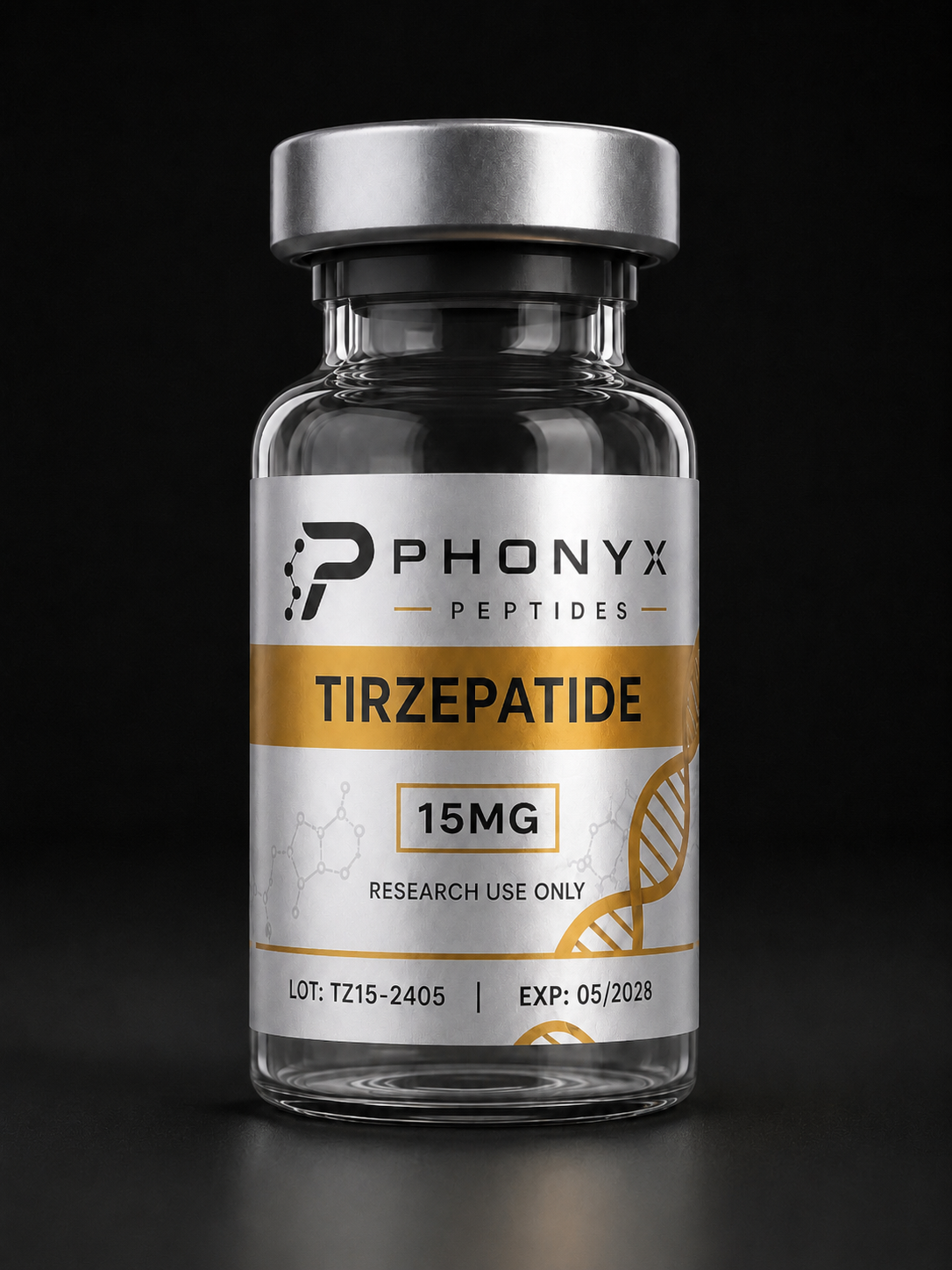
Tirzepatide
A long-acting dual GIP and GLP-1 receptor agonist developed to integrate complementary incretin pathways within a single peptide molecule.
The listed format is the total vial content in the PHONYX research portfolio. It is not a weekly clinical dose.
Interested in this compound?
Contact the PHONYX team for availability and catalogue information.
What is Tirzepatide?
Tirzepatide is a 39-amino-acid synthetic peptide engineered as a dual agonist of the glucose-dependent insulinotropic polypeptide receptor (GIPR) and the glucagon-like peptide-1 receptor (GLP-1R). Its structure is primarily based on the GIP sequence and includes a C20 fatty diacid moiety that supports albumin binding and prolonged systemic exposure.
The molecule was developed for once-weekly subcutaneous administration. The molecule is approved in regulated medicines for specific indications. PHONYX research vials are for laboratory research only.
Dual incretin receptor agonism
GIP receptor
GIPR activation supports glucose-dependent insulin secretion and participates in nutrient handling and adipose-tissue signalling. Tirzepatide has comparatively strong activity at this receptor.
GLP-1 receptor
GLP-1R activation supports glucose-dependent insulin secretion, suppresses inappropriate glucagon secretion, reduces appetite and can delay gastric emptying, particularly during treatment initiation.
Integrated effect
Simultaneous activation of both pathways produces a combined metabolic signal affecting glycaemic regulation, satiety and energy intake. The precise contribution of each receptor remains an active research question.
Receptor profile
| Compound | GLP-1R | GIPR | GCGR |
|---|---|---|---|
| Semaglutide | ✓ | — | — |
| Tirzepatide | ✓ | ✓ | — |
| Retatrutide | ✓ | ✓ | ✓ |
The SURPASS and SURMOUNT programmes
SURPASS Type 2 diabetes programme
The phase 3 SURPASS programme evaluated tirzepatide across a broad range of people with type 2 diabetes, including monotherapy and combination therapy settings. Comparators included placebo, semaglutide 1 mg, insulin degludec and insulin glargine.
SURPASS-2 provided a direct comparison with semaglutide 1 mg and reported greater reductions in glycated haemoglobin and body weight with all three tirzepatide maintenance doses over 40 weeks.
SURMOUNT Obesity and weight-management programme
The SURMOUNT programme studied tirzepatide in adults with obesity or overweight, both with and without type 2 diabetes. SURMOUNT-1 established dose-dependent weight reduction over 72 weeks, while SURMOUNT-4 demonstrated that continued treatment maintained and extended weight loss whereas withdrawal led to substantial regain.
SURMOUNT-5 Head-to-head comparison with semaglutide
In the 72-week head-to-head obesity trial, tirzepatide produced a larger mean percentage reduction in body weight than semaglutide. This comparison used maximum tolerated doses of tirzepatide 10 or 15 mg and semaglutide 1.7 or 2.4 mg.
Stepwise escalation used in pivotal studies
The 2.5 mg initiation level was used for treatment initiation and tolerability rather than as a maintenance dose. Escalation intervals were designed to reduce gastrointestinal intolerance.
Selected published findings
SURMOUNT-1
Mean body-weight change at 72 weeks with 15 mg using the treatment-regimen estimand; placebo change was approximately −3.1%.
SURMOUNT-1
Mean change with 10 mg at 72 weeks under the same estimand.
SURMOUNT-1
Mean change with 5 mg at 72 weeks.
SURMOUNT-5
Mean reduction with tirzepatide versus semaglutide at 72 weeks in the treatment-regimen estimand.
Across the SURPASS programme, tirzepatide also produced substantial reductions in HbA1c and body weight in people with type 2 diabetes. Results should always be interpreted within the population, comparator, dose and statistical estimand of each individual study.
Commonly reported adverse events
Nausea, diarrhoea, vomiting, constipation, dyspepsia and abdominal discomfort.
Long-acting molecular design
Tirzepatide reaches maximum plasma concentration approximately 8 to 72 hours after administration. Its elimination half-life is approximately five days, supporting once-weekly dosing. The fatty diacid side chain enhances albumin binding and reduces renal clearance.
PHONYX portfolio format
Evidence behind the key claims
Frequently asked questions
Is tirzepatide the same as semaglutide?
No. Tirzepatide activates both GIP and GLP-1 receptors, whereas semaglutide selectively activates the GLP-1 receptor.
Is tirzepatide an investigational molecule?
The molecule is approved in regulated medicines for specific indications. PHONYX research vials are for laboratory research only.
What doses were used in pivotal studies?
Major phase 3 programmes evaluated maintenance doses of 5 mg, 10 mg and 15 mg once weekly after a 2.5 mg initiation period and stepwise escalation.
Is the 30 mg vial a clinical weekly dose?
No. It is the total amount of lyophilized compound in the vial and must not be confused with a clinical maintenance dose.
Why are clinical dosing schedules included?
They document published research and regulated trial design. They are not self-administration instructions.
Research Disclaimer
This PHONYX product is presented exclusively for laboratory and scientific research. It is not a branded medicinal product and is not intended for human consumption, self-administration, diagnosis, treatment, cure or prevention of disease. Clinical-study and regulatory information is provided only for documentary and educational context and must not be interpreted as medical advice, a dosing recommendation or instructions for use.
