
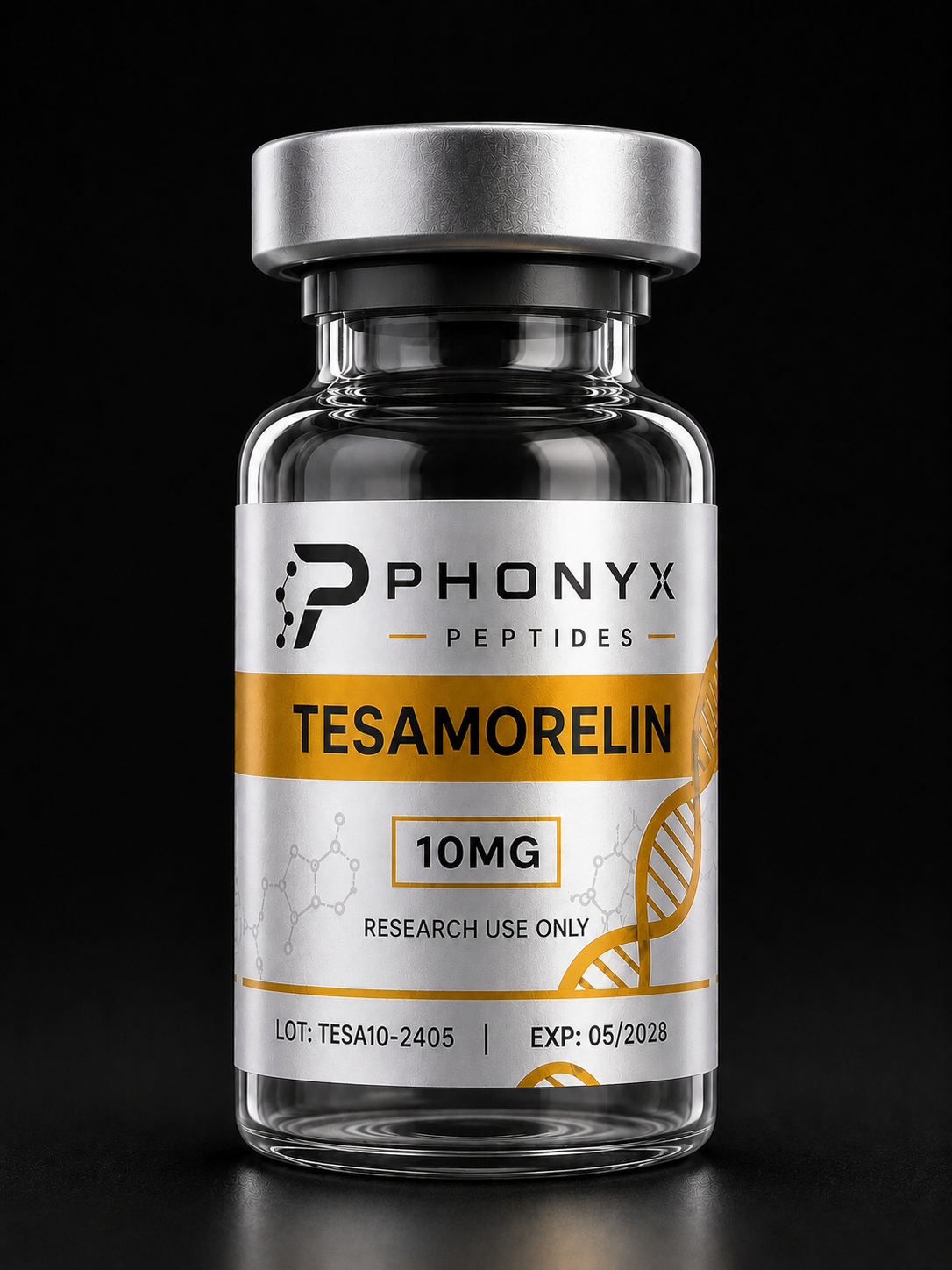
Tesamorelin
A stabilized growth-hormone-releasing hormone analogue studied for activation of the GHRH receptor, pulsatile growth-hormone secretion and changes in visceral adipose tissue.
This selector presents the format planned for the PHONYX research portfolio. It does not initiate a purchase and must not be confused with doses evaluated in published studies.
Interested in this compound?
Contact the PHONYX team for availability and catalogue information.
What is Tesamorelin?
Tesamorelin is a synthetic analogue of human growth-hormone-releasing hormone, based on the 44-amino-acid GHRH sequence and modified to improve resistance to enzymatic degradation. It activates the GHRH receptor in the pituitary and promotes endogenous, physiologically regulated release of growth hormone rather than supplying recombinant growth hormone directly.
The best-established clinical evidence concerns reduction of excess visceral abdominal fat in adults with HIV-associated lipodystrophy. Research has also examined changes in liver fat, IGF-1, body composition and metabolic markers. Those findings are indication-specific and should not be generalized to unsupervised or non-medical use.
GHRH-receptor activation and endogenous GH release
GHRH receptor agonism
Tesamorelin binds the pituitary GHRH receptor and stimulates release of endogenous growth hormone through the native hypothalamic–pituitary axis.
Pulsatile endocrine signalling
Because the compound acts upstream of GH secretion, the response remains subject to physiological feedback and differs from continuous exposure to recombinant growth hormone.
IGF-1 and tissue effects
Increased GH signalling raises circulating IGF-1 and is associated with changes in lipolysis and visceral adipose tissue observed in controlled clinical studies.
How the signalling approach differs
| Compound class | Primary target | Research effect | Material administered |
|---|---|---|---|
| Somatropin | GH receptor after systemic GH exposure | Direct replacement of recombinant GH | Growth hormone itself |
| Tesamorelin | GHRH receptor | Stimulates regulated endogenous GH release | Stabilized GHRH analogue |
| Ipamorelin | GHS-R1a / ghrelin receptor | Stimulates GH through a separate secretagogue pathway | Pentapeptide secretagogue |
Clinical development and studied research fields
Phase 3 HIV-associated abdominal adiposity
Large randomized, double-blind phase 3 programmes evaluated tesamorelin in adults with HIV-associated excess abdominal fat. The principal endpoint was change in visceral adipose tissue measured by computed tomography, with secondary assessments of waist measures, body image, lipids, glucose and IGF-1.
Body composition Visceral fat and trunk-fat research
Across controlled studies, tesamorelin reduced visceral adipose tissue without the same degree of reduction in subcutaneous fat. This selectivity is central to the compound's clinical evidence base.
Hepatic research Liver-fat studies
Smaller randomized studies examined hepatic lipid content in people with HIV and abdominal fat accumulation. Reported reductions in liver fat support continuing investigation of the GH–IGF-1 axis in metabolic and hepatic research.
Evidence limitation Context-specific conclusions
The strongest evidence concerns defined HIV-associated lipodystrophy populations. Claims involving generalized fat loss, bodybuilding, anti-ageing or recovery are not supported by the pivotal clinical programme.
What controlled research reported
Visceral adipose tissue
One 26-week randomized trial reported a 15.2% reduction in VAT versus a 5.0% increase with placebo.
Six-month phase 3 result
A separate pivotal trial reported a 10.9% VAT reduction at six months versus 0.6% with placebo.
Twelve-month continuation
Participants continuing tesamorelin maintained and extended VAT reduction over 12 months.
Net liver-fat effect
A six-month randomized study reported a net reduction in hepatic lipid-to-water percentage compared with placebo.
Benefits were most consistently observed for visceral adipose tissue, selected lipid measures and body-image assessments. In withdrawal phases, improvements in visceral fat were lost after discontinuation, indicating that observed effects were not necessarily persistent without continued study treatment.
Reported observations and clinical limitations
Clinical studies and authorized prescribing information describe injection-site reactions, arthralgia, myalgia, peripheral oedema, paresthesia and glucose-related concerns among relevant observations. Tesamorelin increases IGF-1, so monitoring of IGF-1 and glucose was integral to clinical programmes. Hypersensitivity, active malignancy and disruption of the hypothalamic–pituitary axis are important medical considerations in the approved-product context.
Safety findings from an authorized medicinal product cannot be transferred automatically to an unverified research vial. Purity, identity, sterility, formulation and handling all materially affect risk.
A stabilized GHRH analogue with endocrine-axis activity
Tesamorelin is modified relative to native GHRH to resist cleavage by dipeptidyl peptidase-4. After subcutaneous administration, it produces transient exposure followed by pituitary GHRH-receptor activation and a downstream increase in endogenous GH and IGF-1. Its biological effects therefore reflect both peptide pharmacokinetics and the longer downstream endocrine response.
PHONYX portfolio format
Evidence behind the key claims
Frequently asked questions
Is tesamorelin recombinant growth hormone?
No. Tesamorelin is a GHRH analogue that stimulates endogenous GH release. Somatropin is recombinant growth hormone itself.
What receptor does tesamorelin target?
Its principal target is the growth-hormone-releasing hormone receptor in the pituitary.
What is the strongest evidence base?
The strongest evidence concerns reduction of excess visceral abdominal fat in adults with HIV-associated lipodystrophy.
What dose was used in pivotal published trials?
Major controlled studies used 2 mg subcutaneously once daily for 26 weeks, with some programmes continuing to 52 weeks. This is a description of study design, not a recommendation.
Is the 10 mg format a clinical dose?
No. It is the total vial content planned for the PHONYX research catalogue and must not be interpreted as a dose.
Do effects persist after discontinuation?
In extension studies, reductions in visceral fat were lost after participants switched from tesamorelin to placebo.
Does tesamorelin affect IGF-1?
Yes. Controlled studies reported increased IGF-1, reflecting activation of the endogenous GH–IGF-1 axis.
Can approved-product evidence validate a research vial?
No. Regulatory status and clinical evidence apply only to the authorized product, formulation and indication, not to unrelated research materials.
Research Disclaimer
This compound is presented exclusively for laboratory and scientific research. It is not intended for human consumption, self-administration, diagnostic use, treatment, cure or prevention of disease. Information describing published studies is provided for documentary and educational context only and must not be interpreted as medical advice, a dosing recommendation or instructions for use. Regulatory authorization of a tesamorelin medicinal product does not establish the identity, safety, purity or suitability of this PHONYX research-format material.