
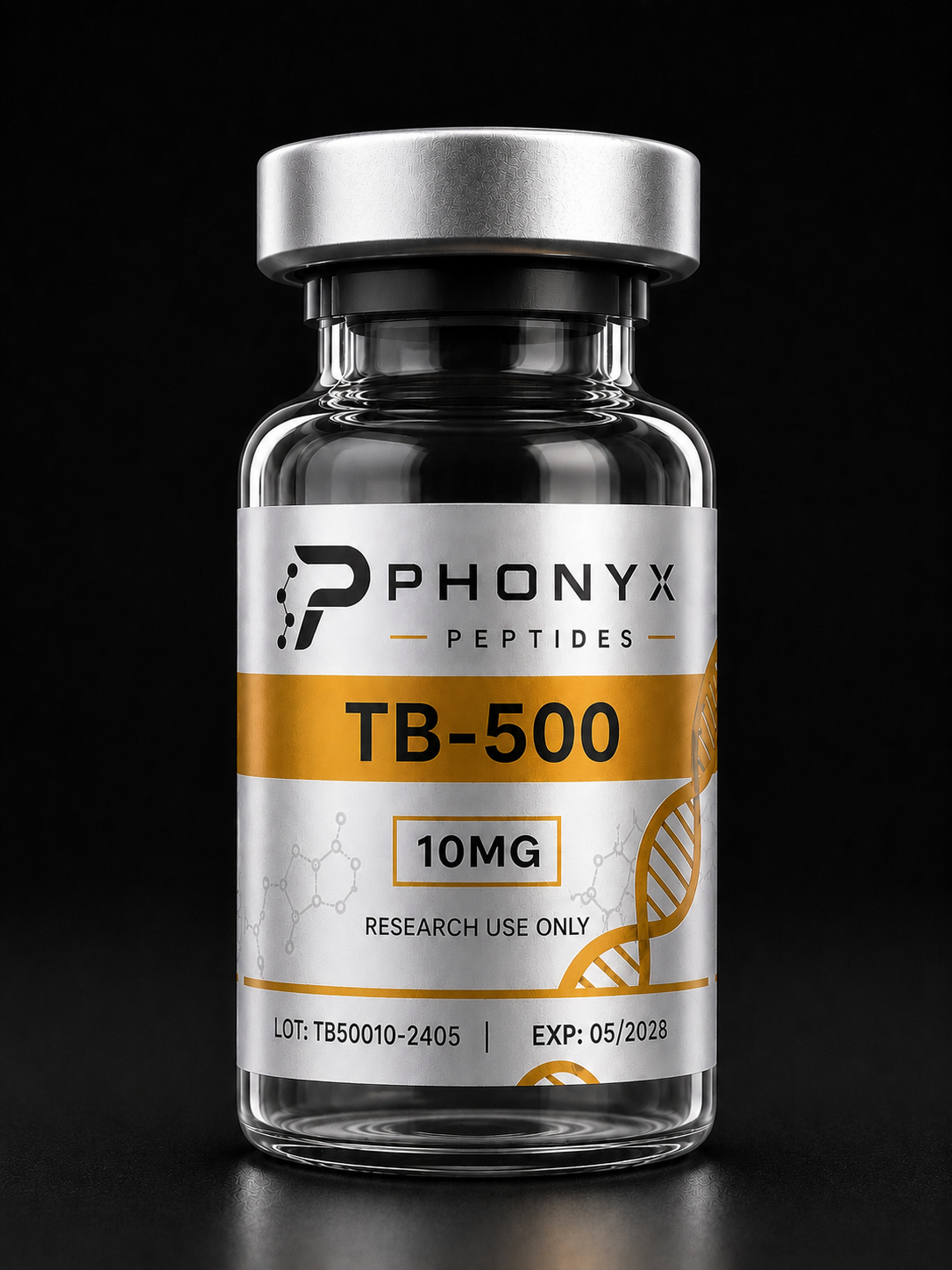
TB-500
A synthetic thymosin-β4-related research fragment examined in the context of actin-associated cell migration, tissue-repair signalling and vascular biology.
This selector presents the format planned for the PHONYX research portfolio. It does not initiate a purchase and must not be interpreted as a dose.
Interested in this compound?
Contact the PHONYX team for availability and catalogue information.
What is TB-500?
TB-500 is a synthetic research peptide based on the biologically active region of thymosin beta 4, a naturally occurring peptide widely expressed in mammalian tissues. It is studied for its involvement in actin regulation, cellular migration, angiogenesis and tissue-repair signalling.
Research interest focuses on the peptide’s ability to influence cytoskeletal dynamics and support the movement of repair-associated cells toward areas of tissue stress. Experimental models have examined muscle, tendon, ligament, skin, cardiovascular and neural repair pathways.
Actin dynamics and repair-associated signalling
Actin-associated biology
The Tβ4 research field centres on interactions with monomeric actin and regulation of cytoskeletal availability, a process relevant to cell shape, motility and migration.
Cell migration
Full-length Tβ4 has been studied for effects on keratinocyte and endothelial-cell migration, processes required during wound closure and vascular remodelling.
Repair signalling
Preclinical studies associate Tβ4 biology with angiogenesis, collagen deposition, inflammatory modulation and protection from selected forms of tissue stress.
Research fields and evidence boundaries
Preclinical Dermal repair and cell migration
Animal and cell studies in the thymosin beta 4 research field reported increased keratinocyte migration, collagen deposition, angiogenesis, re-epithelialization and wound contraction. These findings form the main experimental basis for research into TB-500 and tissue-repair signalling.
Clinical Tβ4 Chronic-wound research
Topical full-length Tβ4 was evaluated in phase 2 venous-ulcer and pressure-ulcer programmes. Reported findings included acceptable tolerability and signals of faster healing in selected wound groups.
Systemic research Emerging TB-500 development
Ongoing research evaluates TB-500-related material in cardiovascular and tissue-repair settings, including safety, tolerability, pharmacokinetics and exploratory vascular biomarkers.
Evidence limitation No validated recovery protocol
There is no established clinical evidence that TB-500 accelerates sports-injury recovery, increases athletic performance or provides a validated systemic tissue-repair protocol in humans.
Findings reported in the thymosin beta 4 research field
Preclinical re-epithelialization
A rat wound model reported increased re-epithelialization after full-length Tβ4 treatment compared with saline controls.
Keratinocyte migration
In vitro experiments reported increased keratinocyte migration under selected Tβ4 conditions.
Topical phase 2 signal
A venous-ulcer study identified this full-length Tβ4 concentration as having potential to accelerate healing.
TB-500 human efficacy
No completed, peer-reviewed human efficacy trial establishes injury-recovery benefits for the fragment.
The reported findings support continued investigation of TB-500-related pathways in cellular migration, angiogenesis and tissue repair. They do not establish an approved medical use or a validated human recovery protocol.
Known observations and major uncertainties
Topical thymosin beta 4 research was described as acceptably tolerated in phase 2 wound studies. However, systemic TB-500 pharmacology, immunogenicity, dose-response relationships, long-term safety and interaction risks remain insufficiently characterized.
Repair and angiogenesis pathways require careful interpretation in malignancy and proliferative disease contexts. In addition, unverified research materials introduce separate risks related to identity, purity, sterility, endotoxin burden, aggregation and handling.
A fragment with an incompletely defined human profile
TB-500 is studied as a synthetic thymosin beta 4–related peptide with research interest centred on broad tissue distribution, actin-associated signalling and cellular migration. Its exact human distribution, metabolism and exposure profile remain incompletely characterized.
Ongoing clinical research is intended to clarify pharmacokinetics, safety and tolerability. A definitive human half-life has not been established in completed peer-reviewed clinical publications.
PHONYX portfolio format
Evidence behind the key claims
Frequently asked questions
How is TB-500 described in research?
TB-500 is described as a synthetic thymosin beta 4–related research peptide investigated for actin regulation, cellular migration, angiogenesis and tissue-repair signalling.
What is the principal research pathway?
The field focuses on actin-associated cytoskeletal regulation, cell migration, angiogenesis and tissue-repair signalling.
Are there completed human efficacy trials for TB-500?
No completed peer-reviewed human efficacy programme establishes the fragment as a treatment for injury recovery or athletic performance.
What dosing has been published for TB-500 itself?
A phase 1/2 fragment study uses sequential dose cohorts, but the public registry does not disclose the individual dose levels. Published topical 0.03% data concern full-length Tβ4, not TB-500.
Can topical Tβ4 wound data be converted into an injectable protocol?
No. The molecule, route, formulation and clinical context differ, so that conversion would not be scientifically valid.
Is the 10 mg vial a clinical dose?
No. It is total vial content for the PHONYX research portfolio and must not be interpreted as a dosing recommendation.
Is the human half-life of TB-500 established?
No robust completed clinical publication currently establishes a specific human half-life for the fragment.
Does evidence for an authorized or clinical-grade Tβ4 product validate this material?
No. Evidence applies to the exact test article, formulation and quality system used in the study, not to unrelated research material.
Research Disclaimer
This compound is presented exclusively for laboratory and scientific research. It is not intended for human consumption, self-administration, diagnostic use, treatment, cure or prevention of disease. Information describing published studies is provided for documentary and educational context only and must not be interpreted as medical advice, a dosing recommendation or instructions for use. The available evidence does not establish the safety or efficacy of this research-format material for human use.