
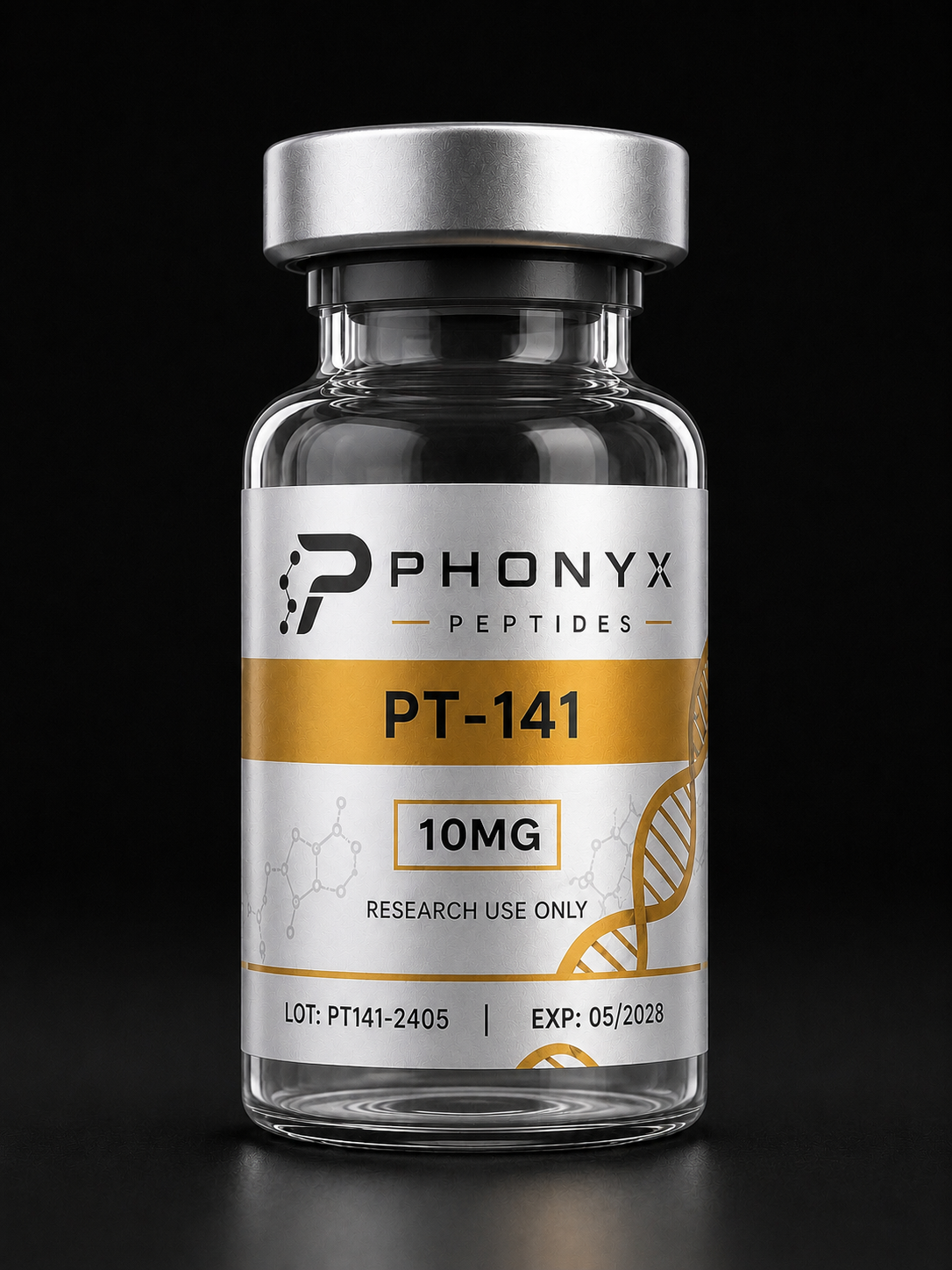
PT-141
A synthetic melanocortin peptide investigated for centrally mediated sexual-desire and arousal signalling through melanocortin receptor pathways.
The listed format is the total vial content in the PHONYX research portfolio. It is not a clinical dose.
What is PT-141?
PT-141 is the research designation commonly associated with bremelanotide, a synthetic cyclic peptide derived from melanocortin biology. Unlike compounds that act primarily through peripheral vascular pathways, bremelanotide has been investigated for effects on centrally regulated sexual desire and arousal.
Its clinical-development programme focused mainly on acquired, generalized hypoactive sexual desire disorder in premenopausal women. Earlier studies also explored sexual arousal responses in both women and men.
Melanocortin receptor signalling
Bremelanotide acts as a melanocortin receptor agonist, with activity particularly associated with MC4R and MC3R. These receptors participate in central neural circuits involved in motivation, reward, autonomic response and sexual behaviour.
From exploratory studies to phase 3
Early studies Intranasal and subcutaneous exploration
Early controlled studies evaluated physiological and subjective sexual responses and helped establish dose ranges and outcome measures.
Phase 2 Dose-ranging research
Randomized studies compared several as-needed subcutaneous doses and assessed desire, distress and satisfying sexual-event measures.
Phase 3 RECONNECT programme
Two randomized, double-blind, placebo-controlled phase 3 trials evaluated bremelanotide in premenopausal women with acquired, generalized hypoactive sexual desire disorder.
Selected research findings
Sexual desire
The RECONNECT trials reported statistically significant improvement in validated desire-domain scores compared with placebo.
Low-desire-related distress
Participants receiving bremelanotide reported significant reductions in distress associated with low sexual desire.
Event-based design
Clinical programmes evaluated administration in anticipation of sexual activity rather than continuous daily exposure.
Extension research
Open-label extension data reported sustained symptom improvement without newly identified safety signals.
Commonly reported adverse events
Nausea, flushing, headache, injection-site reactions and transient increases in blood pressure were among the effects reported in clinical programmes.
As-needed systemic exposure
Subcutaneous bremelanotide was developed for relatively rapid systemic absorption and event-based administration. Clinical protocols generally evaluated dosing before anticipated sexual activity rather than on a fixed daily schedule.
PHONYX portfolio format
Evidence behind the key claims
Frequently asked questions
Are PT-141 and bremelanotide the same compound?
PT-141 is the research-development designation widely associated with bremelanotide.
Does PT-141 work through nitric oxide like PDE5 inhibitors?
Its principal research mechanism is melanocortin receptor signalling in the central nervous system rather than direct inhibition of peripheral PDE5.
What dose was used in phase 3 trials?
The pivotal RECONNECT studies evaluated 1.75 mg administered subcutaneously as needed under controlled clinical protocols.
Was it studied only in women?
The major phase 3 programme focused on premenopausal women with acquired, generalized hypoactive sexual desire disorder, while earlier research also examined responses in men.
Is the 10 mg vial a clinical dose?
No. It is the total amount of lyophilized compound in the vial and must not be interpreted as a single or recommended dose.
Why are clinical schedules shown?
They are included solely to document published scientific research and are not instructions for use.
Research Disclaimer
This PHONYX product is presented exclusively for laboratory and scientific research. It is not intended for human consumption, self-administration, diagnosis, treatment, cure or prevention of disease. Clinical-study information is provided only for documentary and educational context and must not be interpreted as medical advice, a dosing recommendation or instructions for use.