
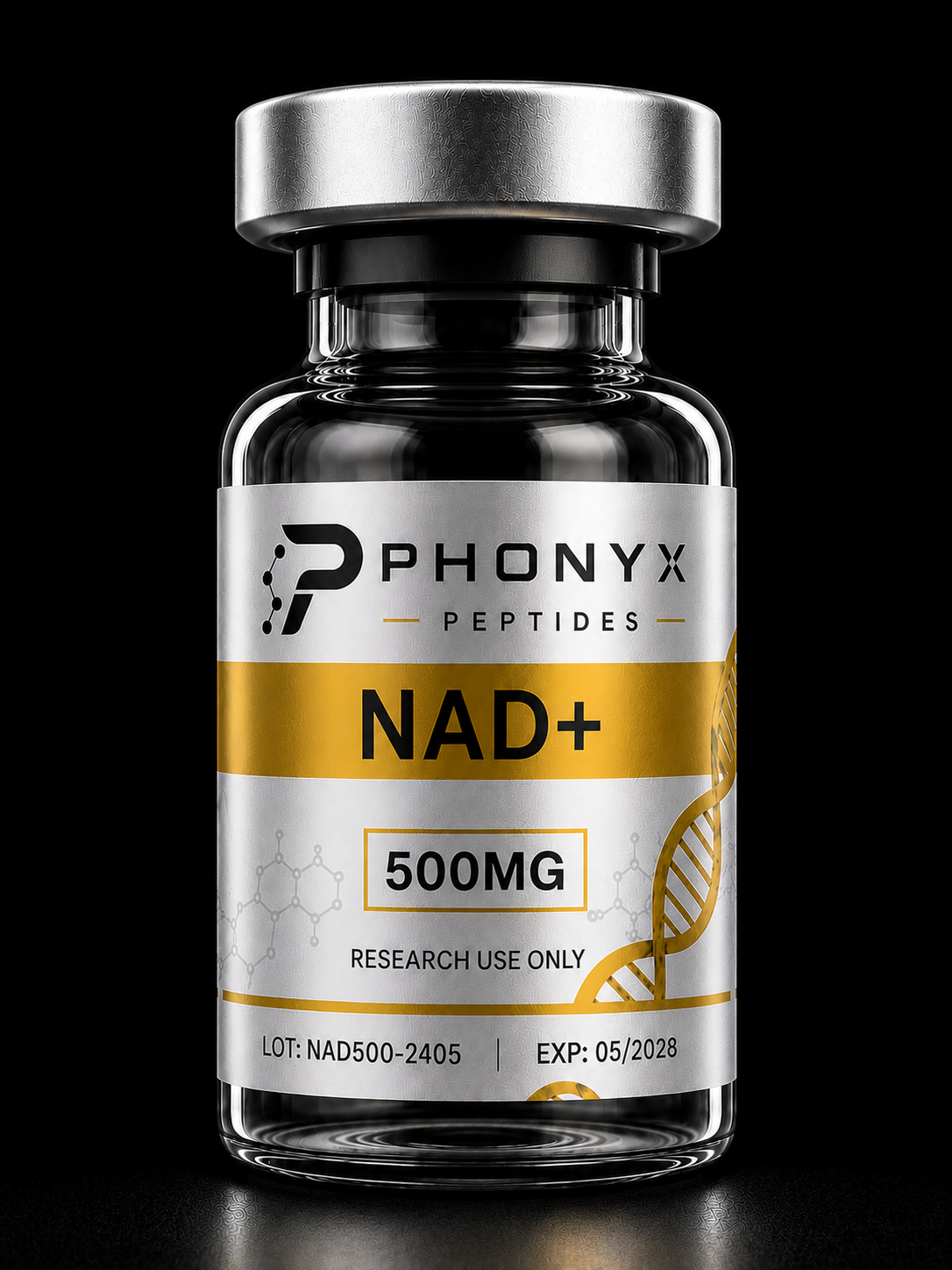
NAD+
Nicotinamide adenine dinucleotide — an essential redox cofactor central to mitochondrial energy production, sirtuin activation, DNA repair and cellular resilience.
The listed formats are total vial contents in the PHONYX research portfolio. They are not single-application amounts.
Interested in this compound?
Contact the PHONYX team for availability and catalogue information.
What is NAD+?
NAD+ (nicotinamide adenine dinucleotide) is a pyridine nucleotide coenzyme present in every living cell. It is not a peptide but a dinucleotide built from an adenine and a nicotinamide nucleotide linked through phosphate groups. NAD+ occupies a central position in oxidation-reduction reactions, mitochondrial respiration and cellular signalling.
The molecule exists in an oxidised form (NAD+) and a reduced form (NADH), both essential for ATP generation and metabolic homeostasis. NAD+ also serves as a consumable substrate for sirtuins (SIRT1–7), PARP enzymes involved in DNA repair, and CD38 — an NADase whose rising activity with age is considered a key driver of the age-related decline in NAD+ levels.
Redox cofactor and consumable substrate
Redox shuttle (NAD+/NADH)
NAD+ is an electron carrier in glycolysis, the Krebs cycle and the electron transport chain. The NAD+/NADH couple is central to mitochondrial ATP synthesis.
Sirtuins and PARP
NAD+ is a co-substrate for sirtuins (SIRT1–7), which deacetylate proteins and optimise mitochondrial function, and for PARP enzymes that participate in DNA repair and genomic stability.
CD38 and ageing
The enzyme CD38 (NADase) degrades NAD+ and is described as a key factor in the age-related decline of NAD+ levels and consequent mitochondrial dysfunction.
NAD+ compared with mitochondrial peptides
| Feature | NAD+ | SS-31 | MOTS-c |
|---|---|---|---|
| Molecule type | Redox cofactor (dinucleotide) | Tetrapeptide | Mitochondrial-derived peptide |
| Mechanism | Metabolic substrate / co-substrate | Structural membrane stabiliser | Signalling peptide |
| Point of action | Sirtuins, PARP, NAD+-dependent enzymes | Inner mitochondrial membrane | AMPK / nuclear transcription |
| Studied route | IV / SC, per protocol | Daily SC | Daily SC in studies |
| Development stage | Research use / supplement context | FDA-approved for Barth syndrome; otherwise experimental | Preclinical / early clinical |
Major areas of investigation
Energy metabolism Mitochondrial ATP production
NAD+ is indispensable for electron transfer in oxidative phosphorylation. Declining NAD+ levels are associated with reduced mitochondrial efficiency, lower ATP output and metabolic decompensation.
Ageing and longevity Sirtuin activation and CD38 dynamics
The age-related decline in intracellular NAD+ is linked to reduced sirtuin activity, impaired DNA repair and mitochondrial dysfunction. Strategies to restore NAD+ are among the most actively studied longevity interventions.
DNA repair PARP substrate availability
NAD+ is consumed by PARP enzymes during the repair of single-strand and double-strand DNA breaks. Adequate NAD+ availability supports genomic stability and cellular resilience under oxidative stress.
Neuroprotection Neuronal energy and resilience
Research indicates that increasing NAD+ availability improves neuronal energy metabolism and reduces neuroinflammation, with protective effects observed in models of ischaemia, excitotoxicity and neurodegeneration.
Addiction recovery IV NAD+ clinical series
Early clinical work described intravenous NAD+ at 500–1000 mg daily in addiction settings. More recent observational series report statistically significant reductions in craving, anxiety and depression scores following NAD+ infusions.
Evidence limitation Controlled clinical data
The strongest controlled human data relate to NAD+ precursors (NMN, NR) rather than direct NAD+ administration. IV and SC NAD+ studies are smaller and predominantly observational.
NAD+ research protocol formats
| Research Protocol | Dose | Frequency | Duration | Cycle Break | Research Objective |
|---|---|---|---|---|---|
| Standard Cellular Maintenance | 50–100 mg | Every other day | 8–12 weeks | 4 weeks | General mitochondrial and energy research design |
| Intensive Regeneration | 100–250 mg | Once daily | 8–12 weeks | 8 weeks | Recovery-focused models and DNA repair research |
| Neurocognitive Focus | 50 mg | Once daily (morning) | 8–12 weeks | 4 weeks | Neuronal resilience and alertness optimisation research |
| Longevity and Metabolism | 50–150 mg | Every other day | 8–12 weeks | 8 weeks | Long-term metabolic and ageing research |
Outcomes reported across NAD+ research
Plasma NAD+ increase
Human IV studies report a 4- to 6-fold rise in plasma NAD+ following infusion protocols.
Lifespan extension
Preclinical models in aged mice report restored mitochondrial function and increased lifespan.
Enzyme activation
Cell-senescence models show improved DNA repair and mitochondrial biogenesis upon NAD+ replenishment.
Addiction research
Observational series report significant reductions in craving, anxiety and depression scores after NAD+ infusions.
Additional endpoints investigated include triglyceride reduction, hepatic steatosis improvement via AMPK activation, improved muscle NAD+/NADH ratio and exercise endurance, and reduced infarct size in brain ischaemia models.
Commonly reported observations
NAD+ is described as generally well tolerated. Most adverse reactions are related to infusion rate and are transient — typically resolving within 24 hours.
Common (infusion-related)
Flushing, nausea, abdominal cramps, headache, dizziness, palpitation sensation.
Less common
Muscle pain, fatigue, sleep disturbance, gastrointestinal discomfort.
Management
Reducing infusion speed or slowing dose escalation is the standard measure for limiting reactions in published protocols.
Molecular profile and kinetics
NAD+ is a small, highly polar molecule with rapid intracellular turnover. The kinetics of exogenous NAD+ are less well characterised than those of classical drugs, which explains the diversity of protocols used in the literature.
Phonyx portfolio formats
Evidence behind the key claims
Frequently asked questions
Is NAD+ a peptide?
No. NAD+ is a dinucleotide redox cofactor, not a peptide. It is built from two nucleotides (adenine and nicotinamide) and acts as a metabolic substrate and co-substrate for enzymes such as sirtuins and PARP.
What does "buffered" mean?
Pure NAD+ is acidic when dissolved. The buffered form is pH-stabilised, making reconstitution gentler and reducing the acidity of the resulting solution.
How does NAD+ differ from SS-31 and MOTS-c?
All three are studied for mitochondrial function but act at different levels. NAD+ is a metabolic substrate, SS-31 structurally stabilises the inner mitochondrial membrane, and MOTS-c is a signalling peptide that influences AMPK.
Why is NAD+ administered by injection rather than orally?
Intact NAD+ has low oral bioavailability — it is degraded to precursors in the digestive tract. Research protocols therefore use IV or SC routes, or work with precursors such as NMN and NR.
Is NAD+ an approved medicine?
No. NAD+ is not approved by the FDA, EMA or other regulatory authorities as a medicinal product. It is available as a research-grade compound and in the context of nutritional supplements and IV protocols.
What is the systemic half-life?
Approximately 1–2 hours. The rapid turnover explains why protocols use repeated administration rather than single large doses.
Why do NAD+ levels decline with age?
Partly because of increased consumption by CD38 and PARP under conditions of chronic inflammation and DNA damage. This decline is associated with reduced sirtuin activity and mitochondrial dysfunction.
Can NAD+ be combined with other research compounds?
In the literature, NAD+ is frequently studied alongside SS-31, MOTS-c, BPC-157, glutathione and NMN/NR for complementary mitochondrial and regenerative research.
What are the available PHONYX formats?
500 mg and 1000 mg vials of buffered, lyophilized NAD+ with purity ≥99%.
How should the vial be stored?
Before reconstitution: room temperature, protected from light and moisture. After reconstitution: refrigerate at 2–8 °C and use within the timeframe specified by the chosen solvent.
Research Disclaimer
This compound is presented exclusively for laboratory and scientific research. It is not intended for human consumption, self-administration, diagnosis, treatment, cure or prevention of disease. Information describing research protocols is provided solely for documentary and educational context and must not be interpreted as medical advice, a dosing recommendation or instructions for use. NAD+ is not an approved medicinal product.