
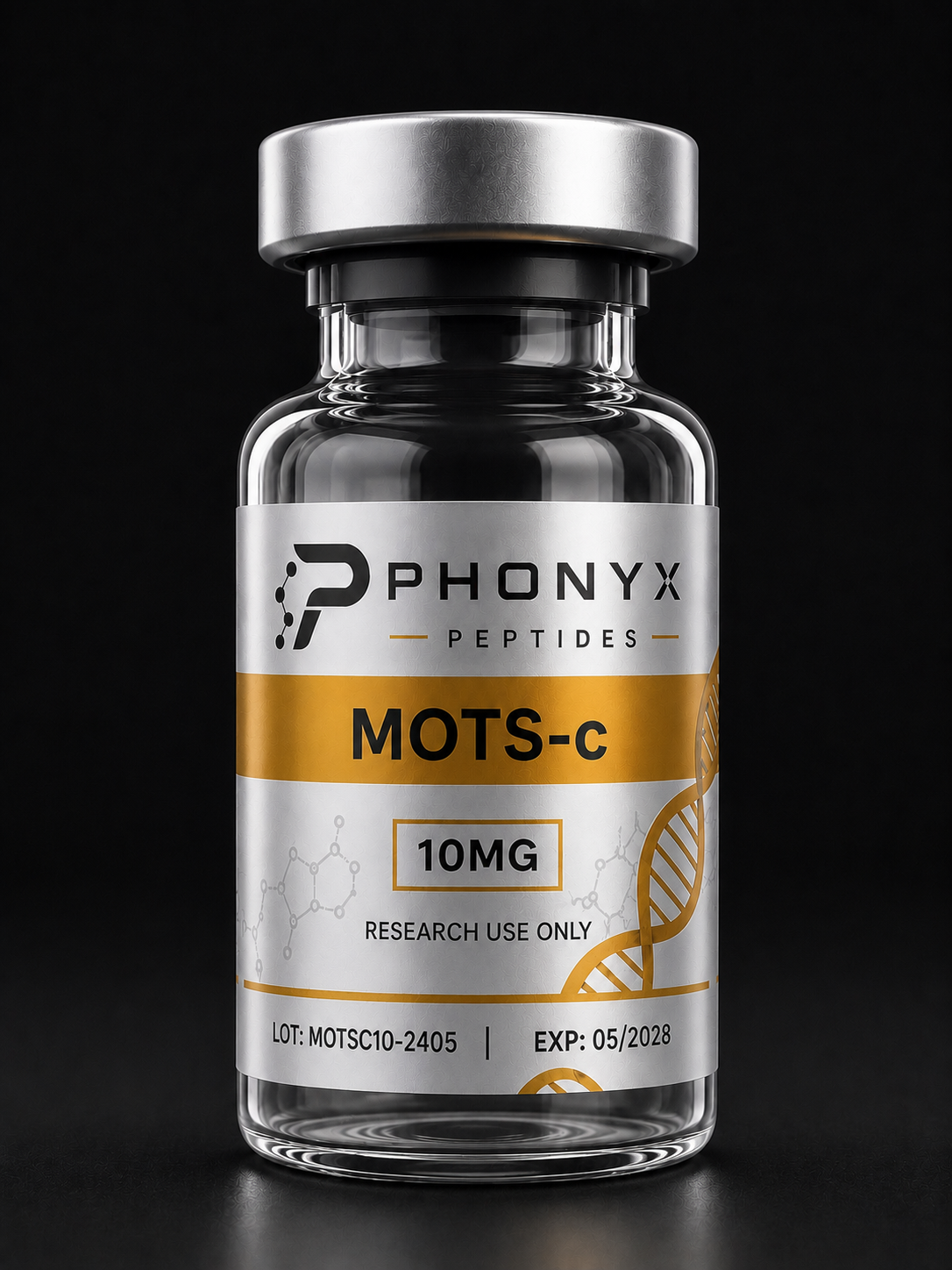
MOTS-c
A 16-amino-acid mitochondrial-derived peptide investigated for its role in cellular stress adaptation, AMPK signalling, glucose metabolism, skeletal-muscle homeostasis and healthy-aging biology.
This selector presents the formats planned for the PHONYX research portfolio. It does not initiate a purchase.
Interested in this compound?
Contact the PHONYX team for availability and catalogue information.
What is MOTS-c?
MOTS-c, short for “mitochondrial open reading frame of the 12S rRNA type-c,” is a small peptide encoded within mitochondrial DNA. It contains 16 amino acids and belongs to a growing group of mitochondrial-derived peptides that act as signalling molecules rather than as conventional structural proteins.
The peptide was first described in 2015 in research linking mitochondrial genetics to whole-body metabolic regulation. Experimental work suggests that MOTS-c can communicate information about cellular energy status, nutrient stress and exercise between mitochondria, the nucleus and peripheral tissues. This places it within the field of mitochondrial retrograde signalling: the process by which mitochondria influence nuclear gene expression and broader physiological adaptation.
MOTS-c is principally investigated in relation to glucose handling, insulin sensitivity, skeletal-muscle metabolism, stress resistance, inflammation, physical capacity and age-related metabolic decline. Most intervention evidence remains preclinical. Human research has mainly examined endogenous MOTS-c concentrations, exercise-induced changes and associations with metabolic or age-related phenotypes.
A peptide encoded inside mitochondrial DNA
Human mitochondrial DNA is a compact circular genome traditionally described as encoding 13 proteins required for oxidative phosphorylation, 22 transfer RNAs and two ribosomal RNAs. The discovery of small open reading frames within regions previously regarded only as ribosomal RNA sequence expanded this view. MOTS-c is encoded within the mitochondrial 12S rRNA region and is translated as a short 16-amino-acid peptide.
This origin is important because mitochondria are not only energy-producing organelles. They are dynamic sensors of nutrient availability, redox balance, inflammation and cellular stress. Mitochondrial-derived peptides appear to function as communication signals that connect these internal conditions to cellular and systemic responses.
Folate–AICAR–AMPK signalling and nuclear adaptation
A central proposed mechanism begins with effects on the folate cycle and de novo purine biosynthesis. Experimental studies report accumulation of the AMP analogue AICAR, followed by activation of AMP-activated protein kinase, or AMPK. AMPK is a conserved cellular energy sensor that responds when energy demand rises relative to supply.
Activation of AMPK favours energy-producing pathways and restrains energy-intensive biosynthesis. In metabolic tissues this can influence glucose uptake, fatty-acid oxidation, mitochondrial biogenesis-related signalling and insulin responsiveness. MOTS-c-associated effects have also been linked with SIRT1 and PGC-1α, which participate in metabolic flexibility and mitochondrial adaptation.
Under metabolic stress, MOTS-c can move from the cytoplasmic or mitochondrial environment into the nucleus. There it has been reported to interact with stress-responsive transcription factors, including NRF2-related antioxidant-response pathways, and to regulate genes involved in proteostasis, metabolism and cellular defence. This nuclear translocation distinguishes MOTS-c from a simple circulating metabolic marker and supports its proposed role as a mitochondrial-to-nuclear messenger.
These mechanisms are supported mainly by cell and animal studies. They describe biological hypotheses and experimental observations, not established therapeutic effects in humans.
Glucose utilisation, insulin sensitivity and metabolic flexibility
The original MOTS-c experiments showed increased glucose utilisation in cultured cells and improved metabolic homeostasis in mice exposed to a high-fat diet. In these models, MOTS-c reduced diet-induced weight gain and insulin resistance without functioning as a direct substitute for insulin.
Skeletal muscle is a major site of glucose disposal and appears to be an important MOTS-c target. Preclinical findings include AMPK activation, increased GLUT4-related signalling and improved muscle insulin sensitivity. MOTS-c has also been studied in relation to hepatic lipid accumulation, adipose-tissue metabolism and the capacity to switch between carbohydrate and fat oxidation.
Human observational evidence is less consistent. Studies have reported altered circulating MOTS-c concentrations in obesity, type 2 diabetes, insulin resistance and aging, but direction and magnitude vary with sex, age, body composition, assay method and disease state. A 2024 systematic review and meta-analysis found meaningful associations between mitochondrial-derived peptide levels and metabolic phenotypes while also highlighting heterogeneity across populations.
An exercise-responsive mitochondrial signal
Exercise is one of the strongest physiological challenges to energy homeostasis. In a controlled human experiment, endogenous MOTS-c increased in skeletal muscle after cycling exercise and rose transiently in circulation during and immediately after exercise before returning toward baseline during recovery.
In mice, exogenous MOTS-c increased running performance across young, middle-aged and old animals. Muscle metabolomics and transcriptomics indicated changes in glycolysis, amino-acid metabolism, stress responses and pathways associated with metabolic adaptation. Importantly, these performance findings are preclinical and cannot be translated directly into claims of enhanced human athletic performance.
More recent mechanistic work has identified casein kinase 2, or CK2, as a direct MOTS-c-binding target involved in skeletal-muscle glucose metabolism and muscle-mass regulation. Research into a naturally occurring mitochondrial DNA variant that changes the MOTS-c sequence also suggests an interaction between genotype, physical activity, diabetes risk and sarcopenia-related traits in men.
Metabolic resilience rather than proven age reversal
Mitochondrial dysfunction, loss of metabolic flexibility, reduced stress resistance and declining skeletal-muscle capacity are recurring features of aging. MOTS-c is of interest because it connects several of these processes: mitochondrial signalling, AMPK activity, exercise adaptation, nuclear stress responses and muscle metabolism.
Circulating and muscle MOTS-c levels have been reported to decline with age in some human cohorts. In old mice, late-life intermittent treatment improved physical capacity and delayed several measures of age-associated functional decline. These findings support research into healthspan, meaning the period of life spent with preserved function, rather than proof of lifespan extension or biological age reversal.
Healthy-aging claims must therefore remain carefully qualified. No robust clinical evidence currently shows that administered MOTS-c slows human aging, extends human lifespan or treats age-related disease. The strongest evidence concerns molecular pathways and animal models, with human work still at an early observational and translational stage.
What has actually been studied in people?
Published human studies have primarily measured naturally occurring MOTS-c rather than testing an administered product. Researchers have examined exercise responses, age-related differences, obesity, insulin resistance, diabetes, cardiovascular status and the functional consequences of mitochondrial genetic variants.
The exercise study in healthy young men demonstrated that endogenous MOTS-c is dynamically regulated by physical activity. Population studies have found associations between MOTS-c levels and metabolic health, but association does not prove that raising MOTS-c would reproduce the same outcome.
As of the current scientific literature, there is no established phase 3 therapeutic programme, approved clinical indication or validated dosing standard for MOTS-c. Public trial registries should be checked for newly registered early-phase studies, but absence of mature interventional data remains a major limitation.
A limited human safety database
Because controlled human administration data are sparse, the safety profile of exogenous MOTS-c is not established. Animal studies can identify biological signals but cannot reliably predict human tolerability, immunogenicity, dose-response relationships or long-term risk.
Relevant unknowns include peptide stability, tissue distribution, renal and hepatic handling, effects on glucose in different metabolic states, interaction with exercise or medication, potential immune responses and consequences of sustained AMPK or stress-response modulation.
Research materials also require analytical confirmation of identity, purity, peptide content, sterility and endotoxin status. A purity percentage alone does not establish suitability for administration or clinical safety.
What is known about exposure?
Endogenous MOTS-c can be detected in tissues and circulation, and its levels may change rapidly in response to exercise or stress. However, validated human pharmacokinetic parameters for administered MOTS-c—including absolute bioavailability, distribution volume, metabolic clearance and terminal half-life—are not well established in peer-reviewed clinical literature.
This uncertainty is why catalogue vial content must not be interpreted as a clinical dose or dosing schedule. Preclinical dose levels are species-specific experimental exposures and are not suitable for direct conversion into human-use instructions.
PHONYX portfolio formats
Evidence behind the key claims
Frequently asked questions
What is MOTS-c?
MOTS-c is a 16-amino-acid signalling peptide encoded within the mitochondrial 12S rRNA region and investigated in metabolism, stress adaptation and aging biology.
How was MOTS-c discovered?
It was reported in 2015 during research into small open reading frames within mitochondrial DNA and their systemic metabolic functions.
Is MOTS-c encoded by mitochondrial DNA?
Yes. Its coding sequence lies within the mitochondrial 12S rRNA region, although translation and trafficking involve interactions between mitochondrial and cellular systems.
How does MOTS-c activate AMPK signalling?
Preclinical work suggests that MOTS-c alters folate and purine metabolism, increases AICAR and thereby activates the cellular energy sensor AMPK.
What is the relationship between MOTS-c and glucose metabolism?
Cell and animal studies link MOTS-c with increased glucose utilisation, skeletal-muscle glucose uptake and improved metabolic flexibility.
Can MOTS-c influence insulin sensitivity?
It improved insulin sensitivity in several mouse models. Human studies currently show associations rather than confirmed therapeutic effects.
Why is MOTS-c studied in exercise physiology?
Exercise increases endogenous MOTS-c in human muscle and circulation, while animal studies connect the peptide with muscle metabolism and physical capacity.
What role does MOTS-c play in mitochondrial function?
It is proposed to act as a mitochondrial stress signal that influences nuclear gene expression, energy metabolism and adaptive responses.
Is MOTS-c being investigated for healthy aging?
Yes, because it is linked with metabolic resilience, muscle function and stress responses. It is not proven to reverse aging or extend human lifespan.
What evidence exists from human studies?
Human evidence mainly concerns endogenous levels, exercise responses and associations with age or metabolic health. Controlled therapeutic evidence remains limited.
How does MOTS-c differ from SS-31?
MOTS-c is a mitochondrially encoded signalling peptide that affects metabolic and nuclear pathways. SS-31 is a synthetic mitochondria-targeted tetrapeptide studied for interactions with cardiolipin and mitochondrial membrane function.
How does MOTS-c differ from GHK-Cu?
MOTS-c is studied mainly in mitochondrial and metabolic signalling. GHK-Cu is a copper-binding tripeptide investigated in extracellular-matrix remodelling, wound biology and skin-related research.
Is MOTS-c approved for clinical use?
No established regulatory approval or routine clinical indication exists for MOTS-c.
What are the current limitations of MOTS-c research?
Most intervention data are preclinical, human pharmacokinetics and safety are insufficiently defined, and observational associations do not prove treatment effects.
Are the 10 mg and 40 mg vial contents clinical doses?
No. They describe total labelled vial content for laboratory research and must not be interpreted as a clinical or recommended dose.
Research Disclaimer
This PHONYX product is presented exclusively for laboratory and scientific research. It is not intended for human consumption, self-administration, diagnosis, treatment, cure or prevention of disease. Information describing experimental or clinical research is provided only for documentary and educational context and must not be interpreted as medical advice, a dosing recommendation or instructions for use.