
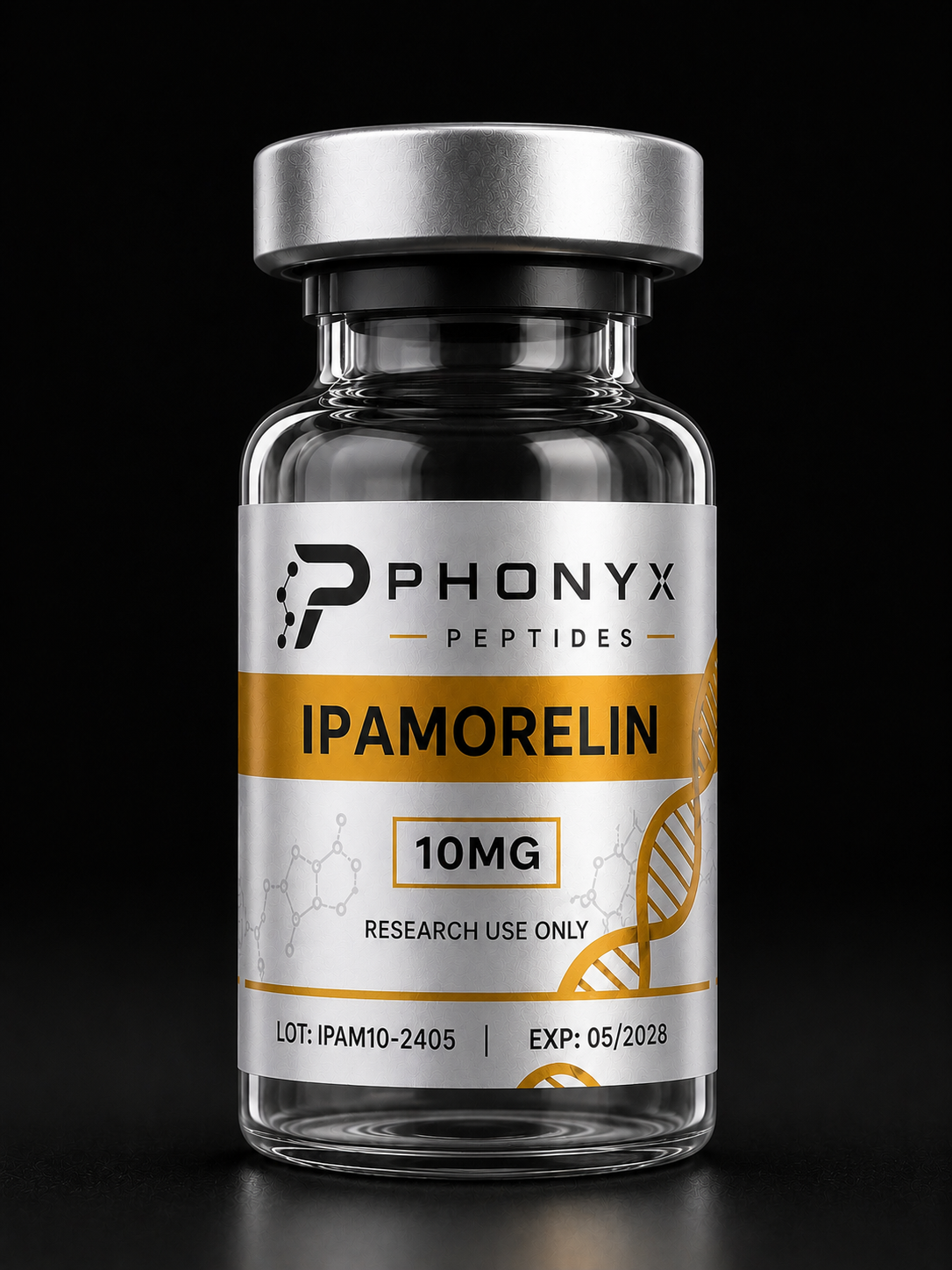
Ipamorelin
A selective pentapeptide growth-hormone secretagogue studied for activation of the ghrelin receptor and short, pulsatile growth-hormone release.
This selector presents the format planned for the Phonyx research portfolio. It does not initiate a purchase and must not be confused with doses evaluated in published studies.
Interested in this compound?
Contact the Phonyx team for availability and catalogue information.
What is Ipamorelin?
Ipamorelin, also identified in early development as NNC 26-0161, is a synthetic pentapeptide growth-hormone secretagogue. It was developed to stimulate endogenous growth-hormone release through the growth-hormone secretagogue receptor, now commonly described as the ghrelin receptor or GHS-R1a.
Its defining research characteristic is selectivity. Early pharmacology found robust growth-hormone release with substantially less stimulation of ACTH and cortisol than older GHRPs such as GHRP-2 and GHRP-6. It is therefore studied as a receptor-selective model of pulsatile GH-axis activation rather than as recombinant growth hormone itself.
Selective ghrelin-receptor signalling
GHS-R1a activation
Ipamorelin acts as an agonist at the growth-hormone secretagogue receptor. Receptor activation in pituitary and hypothalamic pathways produces a discrete episode of endogenous GH release.
Pulsatile GH response
Human pharmacokinetic–pharmacodynamic modelling described a single GH pulse after exposure, with the peak occurring within the first hour and declining thereafter.
Hormonal selectivity
Preclinical comparative work reported little or no meaningful ACTH or cortisol stimulation at exposures well above those required for GH release, distinguishing ipamorelin from several earlier GHRPs.
How the signalling approach differs
| Compound class | Primary target | Research effect | Material administered |
|---|---|---|---|
| Somatropin | GH receptor after systemic GH exposure | Direct replacement of recombinant GH | Growth hormone itself |
| Ipamorelin | GHS-R1a / ghrelin receptor | Stimulates endogenous pulsatile GH release | Selective secretagogue peptide |
| GHRH analogues | GHRH receptor | Stimulate GH through a complementary receptor pathway | GHRH-related peptide |
From receptor pharmacology to human studies
Discovery Selective growth-hormone secretagogue profile
The original pharmacology programme characterised ipamorelin as a potent pentapeptide GHS-R agonist. In comparative animal experiments it produced GH release while avoiding the ACTH and cortisol increases observed with GHRP-2 and GHRP-6. This work established the selective profile that remains central to the compound's scientific identity.
Human PK/PD Dose-escalation study in healthy volunteers
A human dose-escalation study evaluated five intravenous infusion rates in healthy male volunteers. Plasma ipamorelin and GH were measured to model exposure and endocrine response. Pharmacokinetics were approximately dose proportional, terminal half-life was about two hours, and the GH response was characterised by a single pulse peaking at approximately 0.67 hours.
Clinical investigation Postoperative ileus proof-of-concept study
Ipamorelin was later evaluated as a ghrelin-receptor agonist in patients following bowel resection. The randomised proof-of-concept study used a weight-based twice-daily regimen for up to seven days. It was reported as generally well tolerated, but the primary efficacy comparison did not reach statistical significance.
What the research reported
GH peak
The modelled growth-hormone response peaked within the first hour after the controlled infusion.
Terminal half-life
The healthy-volunteer PK study reported a short terminal elimination half-life of approximately two hours.
Systemic exposure
Measured ipamorelin concentrations increased approximately proportionally across the investigated infusion rates.
Postoperative endpoint
The bowel-resection study found no statistically significant difference from placebo in the primary or secondary efficacy analyses.
The strongest direct human evidence concerns pharmacokinetics, growth-hormone release and short-term tolerability. Claims regarding body composition, recovery, sleep or long-term IGF-1 outcomes are not established by large, modern clinical programmes for ipamorelin.
Known limitations and reported observations
The postoperative proof-of-concept study described ipamorelin as generally well tolerated over a short treatment period. However, the evidence base is limited, and the compound is not an approved medicine. Potential class-related concerns include transient headache, flushing, injection-site reactions, fluid retention and changes associated with GH or IGF-1 signalling. Long-term safety, endocrine effects and use in people with active malignancy have not been established.
Short systemic exposure and discrete endocrine response
In the human infusion study, ipamorelin displayed dose-proportional pharmacokinetics, a clearance of approximately 0.078 L/h/kg, a steady-state distribution volume of approximately 0.22 L/kg and a terminal half-life near two hours. The GH response was shorter than systemic peptide exposure and appeared as a single pulse rather than sustained hormone elevation.
Phonyx portfolio format
Evidence behind the key claims
Frequently asked questions
Is ipamorelin recombinant growth hormone?
No. Ipamorelin is a receptor agonist studied for stimulation of endogenous GH release. Somatropin is recombinant human growth hormone itself.
Why is ipamorelin described as selective?
Early comparative pharmacology found GH release with substantially less ACTH and cortisol stimulation than older GHRPs such as GHRP-2 and GHRP-6.
What receptor does ipamorelin target?
Its principal target is the growth-hormone secretagogue receptor, commonly called the ghrelin receptor or GHS-R1a.
What doses have been studied in humans?
Published human work includes controlled intravenous infusion rates from 4.21 to 140.45 nmol/kg and a separate postoperative study using 0.03 mg/kg twice daily for up to seven days. These are descriptions of study protocols, not recommendations.
Is the 10 mg format a clinical dose?
No. It is the total vial content planned for the PHONYX research catalogue and must not be interpreted as a dose.
Is ipamorelin approved for medical use?
No. Ipamorelin remains an investigational research compound and is not an approved medicinal product.
Research Disclaimer
This compound is presented exclusively for laboratory and scientific research. It is not intended for human consumption, self-administration, diagnostic use, treatment, cure or prevention of disease. Information describing published studies is provided for documentary and educational context only and must not be interpreted as medical advice, a dosing recommendation or instructions for use. Ipamorelin is investigational and has not been approved as a medicinal product.