
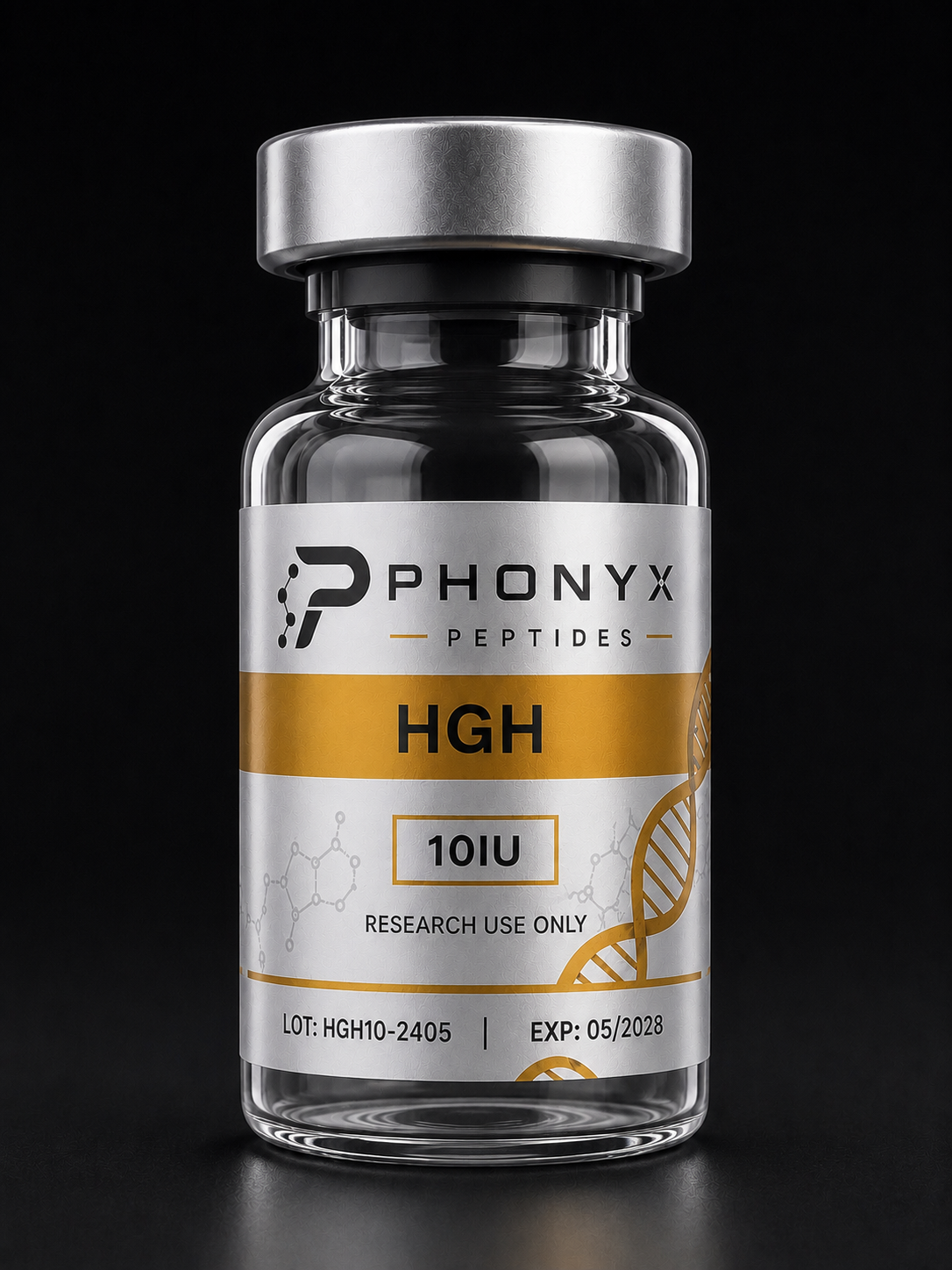
HGH 191AA
Recombinant human growth hormone (somatropin), a 191-amino-acid protein studied across growth, metabolism, tissue maintenance, body composition and the GH–IGF-1 signalling axis.
The listed format is the total vial content in the PHONYX research portfolio. It is not a clinical dose.
Interested in this compound?
Contact the PHONYX team for availability and catalogue information.
What is HGH 191AA?
HGH 191AA is recombinant human growth hormone, also called somatropin. The designation “191AA” refers to its chain of 191 amino acids, arranged to match the principal naturally occurring human growth-hormone sequence. Modern recombinant manufacturing replaced older pituitary-derived preparations and enabled a highly controlled, sequence-defined form for biomedical research and approved replacement therapy.
Growth hormone is produced physiologically by somatotroph cells of the anterior pituitary and released in pulses rather than at a constant rate. Secretion is greatest during deep sleep and is influenced by age, nutritional status, exercise, stress, sex steroids, growth-hormone-releasing hormone, somatostatin and ghrelin-related signalling. Once in circulation, GH acts directly on tissues and indirectly by stimulating insulin-like growth factor 1 (IGF-1), especially in the liver.
The biological role of GH is broader than linear growth. In adults, the GH–IGF-1 axis participates in protein turnover, lipolysis, bone remodelling, extracellular-matrix maintenance, fluid balance and the preservation of lean tissue. For this reason, research spans endocrinology, body composition, rehabilitation, connective tissue, skeletal biology and age-related physiology.
The GH–IGF-1 signalling axis
Somatropin binds the growth hormone receptor (GHR), a membrane receptor expressed in liver, skeletal muscle, adipose tissue, bone, cartilage and many other tissues. Receptor engagement activates intracellular JAK2/STAT signalling and additional pathways including MAPK and PI3K-related cascades. The result is a coordinated change in gene expression, substrate use and tissue turnover.
Direct GH actions
Direct receptor signalling supports lipolysis, modifies glucose and fatty-acid handling, influences sodium and water retention and contributes to protein and connective-tissue turnover.
Hepatic IGF-1
GH stimulates the liver to produce IGF-1 and IGF-binding proteins. Circulating IGF-1 provides a longer-lived marker of integrated GH action than a single GH measurement.
Local IGF-1 signalling
Many tissues also produce IGF-1 locally. Autocrine and paracrine signalling contributes to bone, cartilage, muscle and extracellular-matrix responses.
GH and IGF-1 are related but not interchangeable. GH has prominent metabolic actions, including mobilisation of stored fat, whereas IGF-1 is strongly associated with growth-promoting and anabolic signalling. The final physiological response depends on tissue sensitivity, nutritional state, insulin availability, age, sex, sleep, training and the baseline function of the endocrine axis.
From hormone replacement to systems biology
Replacement research Documented growth-hormone deficiency
The clearest clinical evidence comes from children and adults with confirmed GH deficiency. In adults, replacement studies have reported changes in fat mass, lean mass, quality-of-life measures, lipid profiles and bone turnover. Responses develop over different time scales: fluid and metabolic changes may appear earlier, while skeletal remodelling requires longer observation.
Approved medical context Diagnosis-specific use
Regulatory indications vary by product and jurisdiction, but somatropin products have been used in defined paediatric growth disorders and in confirmed adult GH deficiency. Some formulations also have diagnosis-specific indications such as growth failure associated with Turner syndrome, chronic renal insufficiency or other narrowly defined conditions. These are medical uses requiring specialist diagnosis and monitoring.
Healthy-aging research A separate and controversial question
Age-related decline in GH secretion is physiological and is not equivalent to pituitary GH deficiency. Trials in healthy older adults have often found modest improvements in body composition but inconsistent functional benefits and more adverse events. This distinction is essential when interpreting “anti-aging” claims.
Where the strongest biological signals are observed
Lean mass and fat mass
In GH-deficient adults, replacement commonly shifts body composition toward lower fat mass and higher measured lean mass. In healthy older adults, trials and meta-analyses also show this direction of change, although part of the early lean-mass increase may reflect extracellular fluid and does not automatically translate into greater strength.
Lipolytic signalling
GH promotes mobilisation of fatty acids from adipose tissue and may preferentially influence visceral fat in deficiency states. This action is one reason GH has a distinct metabolic profile compared with IGF-1 alone.
Nitrogen and tissue maintenance
GH can support nitrogen retention and whole-body protein turnover. The magnitude of skeletal-muscle hypertrophy and functional improvement, however, depends heavily on training, nutrition, androgen status, age and baseline deficiency.
Collagen and extracellular matrix
Controlled research in GH-deficient adults has shown increased type-I collagen synthesis markers and increased skin thickness during replacement. These findings support a genuine tissue-remodelling effect but do not prove cosmetic rejuvenation in healthy individuals.
Skin, collagen and connective tissue
The skin contains collagen-rich extracellular matrix that changes with age and endocrine status. GH and IGF-1 can influence fibroblast activity, collagen synthesis and matrix turnover. In a randomized placebo-controlled study of adults with GH deficiency, replacement increased a marker of type-I collagen synthesis and increased measured skin thickness. Similar mechanisms are relevant to tendons, ligaments and other collagen-rich tissues, although tissue adaptation is gradual and clinical outcomes vary.
These observations explain why the GH axis attracts interest in recovery and skin-aging research. A scientifically accurate interpretation is that GH can modify collagen metabolism under defined conditions. It is not evidence that somatropin erases wrinkles, reverses chronological aging or guarantees faster healing.
Bone remodelling
GH and IGF-1 stimulate osteoblast-related activity and increase bone turnover. During early treatment, both formation and resorption markers may rise, and bone-mineral density may not improve immediately. Longer-term replacement in deficient patients can support skeletal health, but responses depend on age, sex hormones, vitamin D, calcium intake, mechanical loading and the duration of observation.
Recovery and physical capacity
By influencing substrate availability, protein turnover and connective-tissue biology, the GH axis is relevant to recovery physiology. Yet increased lean mass is not the same as increased contractile performance. Several trials in healthy older adults reported better body composition without consistent improvements in strength or endurance. The evidence therefore supports a potential role in tissue maintenance more strongly than a universal performance-enhancing effect.
Sleep and circadian physiology
The largest natural GH pulse commonly occurs after sleep onset during slow-wave sleep. Sleep quality, sleep deprivation and circadian disruption can alter GH secretion. This relationship is bidirectional at the level of endocrine physiology, but exogenous GH should not be presented as a sleep treatment. Sleep remains one of the principal natural regulators of the axis.
Potential anti-age signals—and their limits
GH secretion and circulating IGF-1 generally decline with age, a pattern sometimes called the somatopause. Because aging is also associated with reduced lean mass, increased visceral fat, thinner skin and lower bone mass, researchers have examined whether restoring a more youthful GH/IGF-1 profile might modify these features.
Randomized studies in healthy older people have repeatedly observed modest increases in lean body mass and reductions in fat mass. These findings are real but must be interpreted with caution: lean-mass measurements can be affected by fluid retention, improvements in strength are inconsistent, and adverse effects occur more often than with placebo. A systematic review concluded that the balance of evidence does not support GH as an anti-aging therapy for healthy elderly people.
The most defensible healthy-aging discussion therefore focuses on mechanisms and measurable physiological domains: body composition, collagen turnover, bone remodelling and recovery biology. These domains are relevant to aging research, but none is a validated surrogate for longer life, slower biological aging or broad rejuvenation.
What research supports versus what it does not establish
| Supported research signal | Not established |
|---|---|
| Reduced fat mass in many controlled studies | Guaranteed long-term weight control |
| Increased measured lean mass | Proportional increase in strength or athletic performance |
| Increased collagen turnover in deficiency states | Reversal of visible aging in healthy adults |
| Increased bone turnover | Rapid or universal improvement in bone density |
| Higher IGF-1 during exposure | Longer lifespan or slower biological aging |
Predictable effects of excessive GH signalling
Common dose-related effects include fluid retention, peripheral oedema, joint pain, muscle discomfort, paraesthesia and carpal-tunnel symptoms. GH can reduce insulin sensitivity and may increase fasting glucose, particularly in older adults or people with obesity, prediabetes or other metabolic risk factors.
Because GH can influence tissue growth and the IGF-1 pathway, active malignancy is an important contraindication in approved prescribing information. Clinical use also requires attention to intracranial hypertension, severe acute illness, diabetic retinopathy, sleep-disordered breathing in selected syndromes and interactions with thyroid, adrenal and sex-steroid replacement.
Long-term supraphysiological exposure is biologically different from replacement of documented deficiency. Chronic excess GH, as seen in acromegaly, is associated with cardiometabolic, musculoskeletal and soft-tissue complications. This is why research interpretation must distinguish physiological replacement from unmonitored or excessive exposure.
Short circulating exposure, longer downstream signalling
Endogenous GH is secreted in pulses and has a relatively short circulating half-life. Subcutaneous recombinant GH produces a broader exposure profile than a natural pulse, while downstream IGF-1 and IGF-binding-protein responses persist longer. This difference explains why a random GH blood measurement can be difficult to interpret and why IGF-1 is frequently used as an integrated biomarker in clinical monitoring.
PHONYX portfolio format
Evidence behind the key claims
Frequently asked questions
Why is it called HGH 191AA?
The principal human growth-hormone protein contains 191 amino acids. “AA” is shorthand for amino acids.
Are HGH and somatropin the same?
Somatropin is the generic name used for recombinant human growth hormone with the human 191-amino-acid sequence.
What is the difference between GH and IGF-1?
GH is the pituitary hormone that activates the GH receptor. IGF-1 is a downstream mediator produced in the liver and locally in tissues. They overlap biologically but have distinct metabolic and growth-related actions.
Does HGH directly burn fat?
GH has direct lipolytic effects and can shift substrate use toward fatty acids. Clinical changes in fat mass vary with baseline deficiency, dose, duration, diet and metabolic health.
Does increased lean mass always mean more muscle strength?
No. Controlled studies in healthy older adults often show increased measured lean mass without proportional gains in strength or function.
Can HGH increase collagen synthesis?
Replacement studies in GH-deficient adults have demonstrated increased collagen-synthesis markers and increased skin thickness. This does not establish cosmetic rejuvenation in healthy adults.
Is HGH proven to reverse aging?
No. Evidence does not show reversal of biological aging or extension of lifespan. Systematic reviews do not recommend GH as anti-aging therapy in healthy older adults.
Why is IGF-1 monitored?
GH secretion is pulsatile, making single GH values difficult to interpret. IGF-1 is more stable and reflects integrated activity of the GH axis, although it must be interpreted using age-adjusted ranges and clinical context.
Does HGH improve bone density quickly?
No. Bone turnover may rise before any density change is visible, and meaningful skeletal assessment generally requires longer observation.
Can HGH affect glucose?
Yes. GH can reduce insulin sensitivity and increase fasting glucose, particularly in susceptible individuals.
What adverse effects are commonly reported?
Fluid retention, oedema, joint discomfort, muscle pain, paraesthesia and carpal-tunnel symptoms are among the most common dose-related effects.
Is HGH the same as CJC-1295 or Ipamorelin?
No. Somatropin is recombinant GH itself. CJC-1295 and ipamorelin are secretagogue-related research peptides intended to stimulate endogenous GH release through different receptors.
Why does natural GH peak during sleep?
GH secretion is strongly linked to slow-wave sleep and hypothalamic pulse regulation. The largest daily pulse often occurs shortly after sleep onset.
Is the 10 IU vial a single dose?
No. It is the total labelled vial content and must not be interpreted as a clinical or recommended dose.
What is the strongest evidence base for somatropin?
The strongest evidence concerns replacement in carefully diagnosed GH deficiency. Evidence in healthy aging is less favourable and shows a narrower benefit-to-risk balance.
Research Disclaimer
This PHONYX product is presented exclusively for laboratory and scientific research. It is not intended for human consumption, self-administration, diagnosis, treatment, cure or prevention of disease. Clinical-study information is provided only for documentary and educational context and must not be interpreted as medical advice, a dosing recommendation or instructions for use.